

How Much Do Funded Traders Make? The Realistic Math Behind the Screenshots
Forget the Lamborghini screenshots. The honest math of funded account incentive payouts at realistic monthly return rates, tier by tier.
The question everyone asks, answered honestly
Social media will show you a screenshot of a five figure payout and let you assume it is typical. It is not, and any firm that implies otherwise is selling you something. What we can do is show you the actual math of the model, because the model itself is genuinely compelling without exaggeration.
Everything below describes simulated trading performance converting to real incentive payouts under a 90% split. Nothing here is a promise of income. It is arithmetic.
The variable that matters: your monthly return rate
Professional money managers consider 2% to 4% a strong month. Skilled retail traders on a disciplined process land somewhere near that over time, with variance in both directions. Run the numbers at those rates rather than the 20% months that screenshots celebrate:
- $25K account, 3% month: $750 simulated profit × 90% = $675 payout
- $50K account, 3% month: $1,500 × 90% = $1,350 payout
- $100K account, 3% month: $3,000 × 90% = $2,700 payout
- $100K account, 5% month: $5,000 × 90% = $4,500 payout
The insight is that the funded model converts skill into scale. A 3% month is a 3% month whether your personal account is $2,000 or your simulated account is $100,000. The skill is identical. The incentive payout differs by fifty times.
Why the average participant makes less than that
Honesty requires the other half of the math. Most participants do not pass the evaluation on the first attempt, and evaluation fees are real money. A realistic accounting includes them:
- Two evaluation attempts before passing is common even for capable traders
- Months with zero or negative simulated returns happen to everyone, and a 90% split of nothing is nothing
- The drawdown rules that protect the model also end accounts: a funded account that breaches its 6% max loss goes back to evaluation
This is why the consistent traders treat the first $250 eligibility threshold and the five day minimum not as obstacles but as the firm filtering for exactly the kind of trading that lasts.
What separates the earners
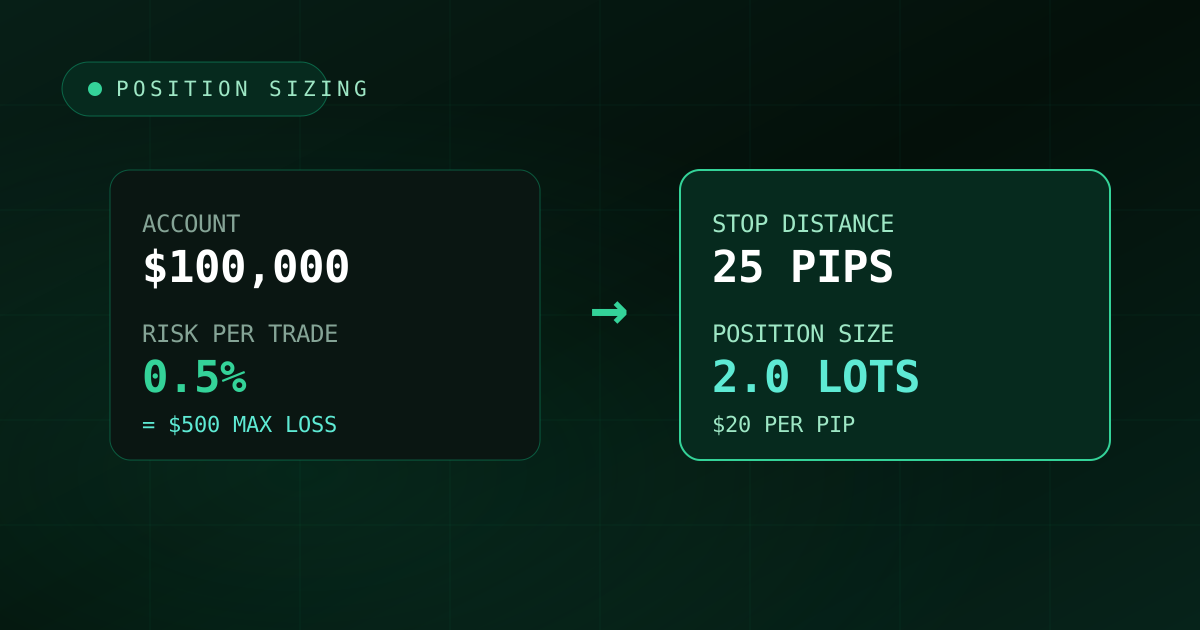
The participants who collect payouts month after month share three habits, none of which are secrets: they risk a fixed fraction per trade and never improvise sizing, they stop trading well before the daily cap on red days, and they request payouts regularly instead of letting a good month ride into an ego month.
Start with the tier your discipline can carry, not the one your ambition wants. The math above works at every size, and moving up a tier after a proven quarter costs far less than blowing the big one learning lessons a small one teaches. When you are ready to run your own numbers, the pricing page lists every tier side by side.
Ready to put this into practice?
One-step evaluation. 90% profit split. No monthly fees.
See pricing →